

How to Choose Wall Art for Your Living Room Using Family Portraits
Most people think about the photograph first and the wall second. It works better the other way around.
Here's how to think about wall art before your session even happens, so what you end up with actually belongs in your home.
Start with the wall, not the photo
Walk into your living room and look at the wall above your couch. How wide is it? What color is it? What's already near it: a lamp, a window, a bookshelf? That wall has a personality, and the art you hang there either fits it or fights it.
A warm neutral room with wood tones wants earth tones in the portrait. A cooler, modern room wants softer palettes. A busy room needs one strong piece, not a gallery wall. A simple room can carry more.
This is exactly why I ask about your home before we plan your session. The art is going there. It should look like it was made for the room, because it was.
Size is the thing almost everyone gets wrong
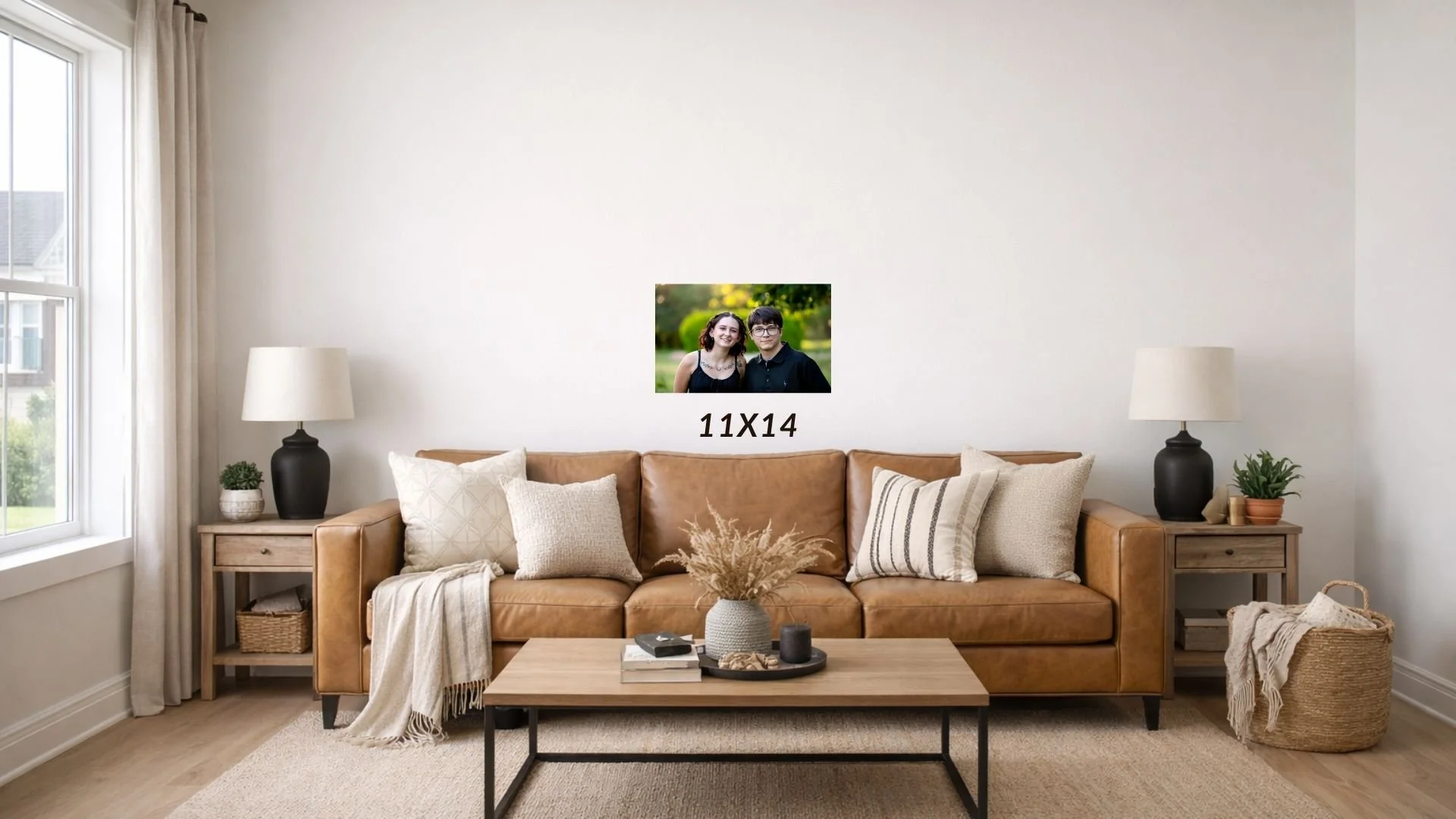
Too small. Almost always too small. A single 11x14 above a seven-foot sofa looks lost. The general rule is that your art should fill about two-thirds the width of the furniture beneath it. Over most sofas, that's somewhere between 36 and 48 inches wide, which means a 20x30 is usually your starting point, not your splurge.
This is why the reveal happens in your home. You see the image projected at real size on your actual wall. You know immediately whether it's right. No guessing, no ordering something and hoping it works.

One strong piece or a grouping
Both work. Neither is wrong. The question is your wall and your room.
One large piece makes a statement. It's simple, it ages well, and it doesn't require a design eye to pull off. A grouping tells more of the story and works well in hallways and stairwells where you view things up close.
If you're not sure, start with one. You can always add.
Canvas or frame
Canvas wraps read more modern and casual. They work in living rooms, family rooms, and open-plan spaces. Framed pieces read more formal and finished. They work in dining rooms, entryways, and anywhere with traditional trim and millwork.
If your home is somewhere in between, framed usually wins because it bridges both directions.
The question I ask every family
When you walk past this wall in five years, what do you want to feel?
That's the answer that tells me what belongs there more than any measurement or style guide.
